Same Blood, Different Flags
The question nobody asks at the World Cup — and the eight (!) pair of brothers of 2026 who answer it

On 23 June 2010, in Johannesburg, two brothers walked out onto the same pitch at the FIFA World Cup and lined up on opposite sides. Kevin-Prince Boateng wore the black and gold of Ghana. Jérôme Boateng wore the white of Germany. Same father, same Ghanaian roots, same Berlin childhood, same Hertha academy. Kevin-Prince had even represented Germany at youth level and won the Fritz Walter Medal, the prize for Germany’s best under-19 player, before eventually feeling the pull of something older. Jérôme had never been to Ghana. Germany was the only country he knew.
The press went wild for the subplot. Would Jérôme speak to his brother before kick-off? (He hadn’t, for weeks, furious about a tackle Kevin-Prince had put on Germany’s captain in the FA Cup final.) What would their father do? How would they greet each other on the pitch? It was irresistible and it was covered almost entirely as human drama: a family story that added spice to a group game.
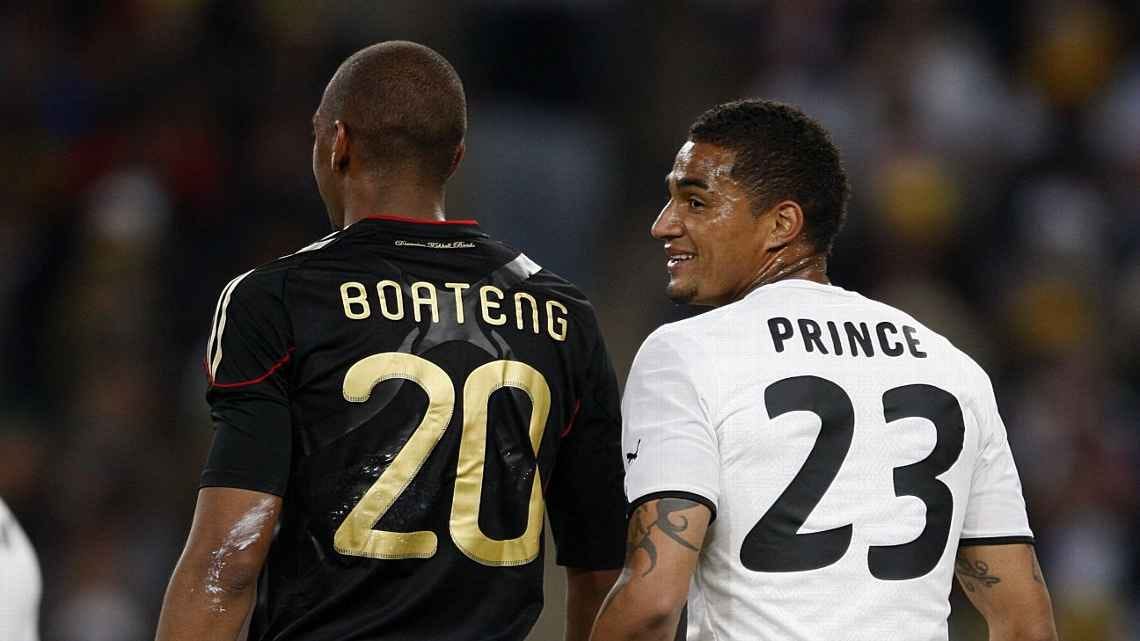
Almost nobody asked the structural question hidden inside it. Why did two brothers from the same household end up wearing different shirts? What does that tell us about how nationality works about migration, identity, belonging, and the entirely arbitrary machinery that determines which flag a player pulls over his head? The Boateng story was treated as a curiosity. It is, in fact, a window.
Now, sixteen years later, that window is wide open. In the group stage of the 2026 FIFA World Cup, spread across arenas in the United States, Canada, and Mexico, the same story is playing out on multiple pitches simultaneously and still almost nobody is asking the question. France beat Norway 4-1 on Friday with a squad whose players were born in Martinique, Guinea-Bissau, Ivory Coast, and the Parisian banlieues. Cape Verde drew 0-0 with Saudi Arabia with a team more than half of whom were born in Rotterdam and Lisbon. The Netherlands demolished Tunisia 3-1 with a squad built substantially from the Dutch-Caribbean diaspora. And this weekend, Ghana face Croatia, with Iñaki Williams wearing Ghana’s colours, while his brother Nico represents Spain, the reigning European champions, in a different group entirely.
The data is not hidden. It is right there on every squad list, in every birthplace column. At this tournament, roughly one in five players was not born in the country they represent. The corridors of migration are written into the tournament’s DNA -Ghana to Spain, Ivory Coast to France, Curaçao and Cape Verde to the Netherlands, Scotland to Australia. And yet the television coverage celebrates national identity, the commentary box talks about mentality and character, the politicians pose with jerseys, and the structural question: how did these players end up here, and what does that tell us about the world goes almost entirely unasked.
This piece asks it. Not through data - though the data is extraordinary - but through the brothers. Because nothing makes the question more vivid, or more human, than two people who share the same blood, the same parents, the same bedroom, the same first ball in the same backyard, and arrive at different answers to the question: who are you, when the world asks you to choose?
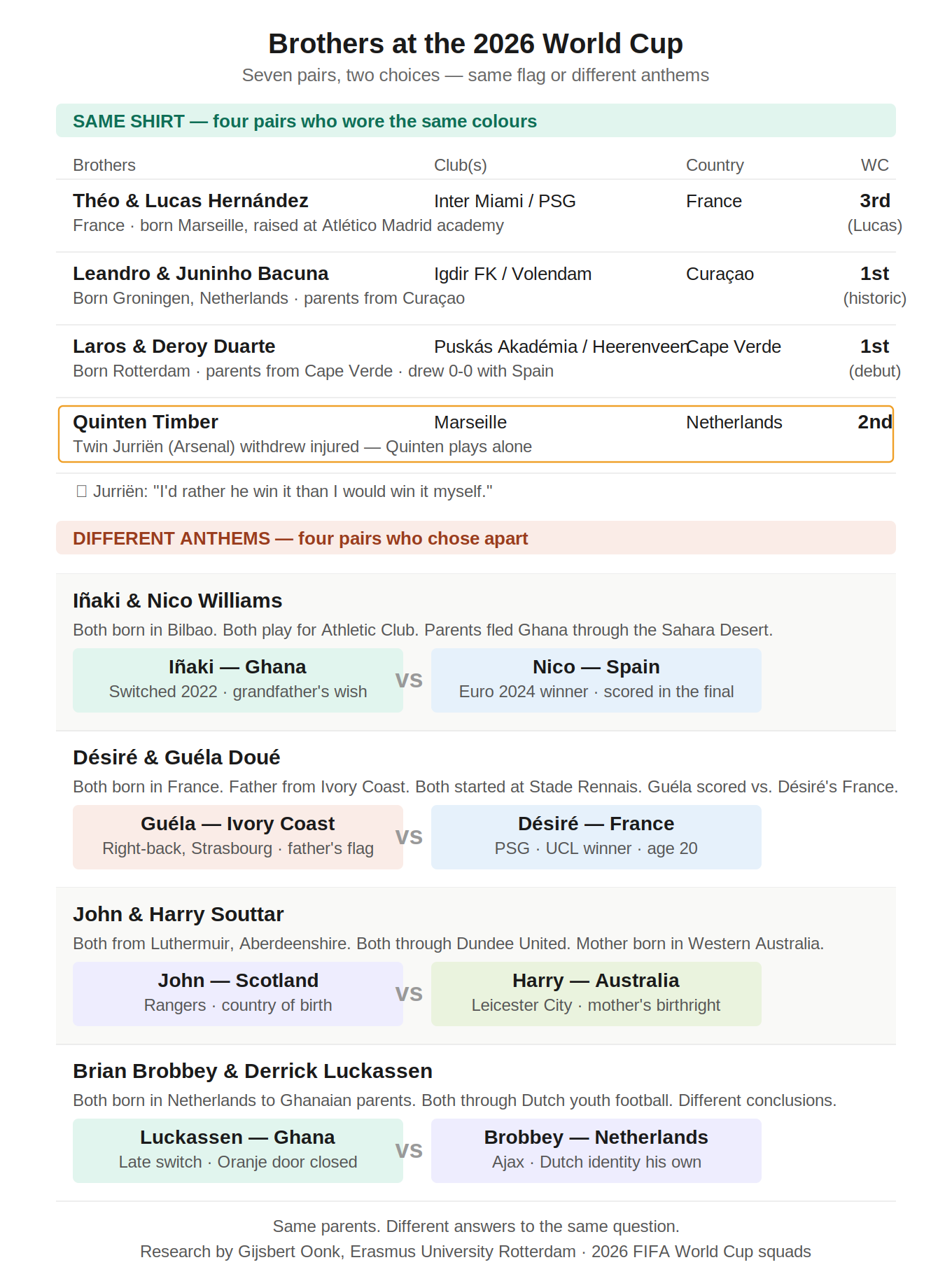
The 2026 World Cup features at least seven pairs of brothers among its 48 competing nations. Four are wearing the same shirt. Four are not. Together, they tell a story that stretches far beyond sport — about migration, belonging, the inheritance of identity, and the quiet, enormous weight of what it means to pick a side.
The 2026 FIFA World Cup, spread across the United States, Canada, and Mexico, features at least seven sets of brothers among its 48 competing nations. Four of those pairs are wearing the same shirt. Four are not. Together, they tell a story that stretches far beyond sport — about migration, belonging, the inheritance of identity, and the quiet, enormous question of who you are when the world asks you to pick a side.
PART ONE: THE SAME SHIRT
France — Théo and Lucas Hernández
They grew up in the academy at Atlético de Madrid. Same dormitory, same drills, same coach’s voice echoing across the same training pitch in the Spanish capital. Yet when Lucas Hernández — two years older — made his debut for France in 2018, Théo had to wait another three years for his.
The family background is Spanish-French: their father, Jean-François Hernández, played professional football in France. The boys were born in Marseille before the family relocated to Madrid for his career. Their French nationality was never in question; it was always the flag they would play under. What was never guaranteed was that both would make it to the very top, and if they did, they might be selected together.
In 2021, when Théo finally earned his senior debut alongside Lucas, they became the first brothers to start together for France since 1932. The statistic tells you something about how rare the achievement is. The story of Qatar 2022 tells you something about the emotional weight they now carry.
Lucas was thirteen minutes into France’s opening game against Australia when he went down clutching his knee. Anterior cruciate ligament, right leg. His World Cup was over. His brother, already on the bench, came on to replace him. Théo went on to score in the semi-final against Morocco, driving France to the final they would lose on penalties to Argentina. ‘I’m playing for both myself and for Lulu,’ he said during the tournament. ‘He told me we need to win this, to bring the Cup home for him.’
At 2026, with both healthy and in form — Lucas at Paris Saint-Germain, Théo at Inter Miami, where he became the first Frenchman to be named to a World Cup squad while playing outside a European league — they are back together. The question that drove one brother onto the pitch in Qatar now drives them both: can they win the thing that Lucas missed?
Curaçao — Leandro and Juninho Bacuna
The Bacuna brothers were born in Groningen, a canal-laced university city in the northern Netherlands, far from the Caribbean island where their parents grew up. At home, the family spoke Papiamento, the creole language that emerged among enslaved people on Curaçao, born from Dutch, Spanish, Portuguese, and West African roots. Outside the house, they spoke Dutch.
Both progressed through Dutch youth football. Leandro played for the Netherlands Under-21s. Juninho reached the same level. Neither was selected for the senior Oranje squad. And yet the choice to represent Curaçao was never primarily about being overlooked — it was something older and more deliberate than that.
Leandro was the pioneer. When he switched allegiance to Curaçao in 2016, the national team was still building its identity following the island’s autonomy from the Netherlands Antilles in 2010. ‘You have to feel it with your heart to join,’ he has said. He became captain. He became the record appearance holder. And he opened a door that others — including his younger brother, and later former Manchester United winger Tahith Chong — walked through.
Juninho followed in 2019. Together, they helped lead Curaçao to the unthinkable: qualification for the 2026 World Cup, making the island — home to around 150,000 people; the smallest nation ever to reach a World Cup. When the qualifying draw was sealed with a goalless draw in Jamaica in November 2025, a homecoming parade toured Willemstad. Leandro said he had never seen so many people in the streets. On an island where baseball is the national obsession, football had, for one night, brought everyone together.
They played in North America as captain and creator;roles they have earned across years of belief in something that nobody else thought possible.
Cape Verde — Laros and Deroy Duarte
Here is an image that contains a world. A young boy is doing keepy-uppies with a battered ball along the touchline. He is five years old. The coaches are there to look at his older brother, who is in a trial session for the Stade Rennais Under-9s. At the end of the session, the club signs both of them.
The boy doing keepy-uppies was Désiré Doué. The older brother was Guéla. But the Duarte brothers - Laros and Deroy, both born in Rotterdam - have a story with a similar texture: two children of Cape Verdean parents, raised in the Netherlands, choosing to play for the country their family came from.
Laros, three years the elder, played through the Dutch youth system from Under-16 to Under-20 level before making his senior debut for Cape Verde in 2024. Deroy — who made his Cape Verde debut two years earlier, in 2022, despite being younger — was already in the team waiting for him. In Atlanta on 15 June 2026, Cape Verde drew 0-0 with Spain in one of the tournament’s great shocks. The brothers played in the same midfield. When Laros was substituted, with his brother still on the pitch, he said afterwards: ‘On the pitch you don’t really realise it. When the whistle blows, it’s a party.’ Their parents, watching in the stands, were crying.
Across the tournament, the Bacunas and the Duartes are doing something structurally similar: taking the Dutch football pipeline — the academies, the development pathway, the technical education — and delivering it to the Caribbean and the Atlantic. This is what Rotterdam and Groningen look like in the final stages of a World Cup.
Netherlands — Quinten Timber (and the brother who should have been there)
This story begins with what is absent.
Ronald Koeman’s original squad for 2026 included twin brothers: Quinten Timber of Marseille and Jurriën Timber of Arsenal. Both of Curaçaoan descent — their parents are from the island — they were set to become one of the great same-nation sibling partnerships in Dutch tournament history, following in the footsteps of Ronald and Frank de Boer, and René and Willy van de Kerkhof.
Then Jurriën’s groin injury, which had kept him out of the final weeks of Arsenal’s Premier League-winning season, failed to heal in time. He was withdrawn from the squad just before the opening game. He flew to Miami. He watched from a distance.
‘Watching the first game will be the hardest,’ he told De Telegraaf from his holiday. ‘But I’ll try to enjoy seeing my little brother there. I know how special it is to be there.’ And then: ‘I’d rather he win it than I would win it myself.’
The sentence lands with the full weight of what fraternal love actually means. Not sentiment, but something harder: the genuine subordination of your own desire to someone else’s fortune. Jurriën Timber had already missed Euro 2024 with an ACL injury. Missing a second major tournament, with his twin brother playing in it, is a specific kind of grief. Quinten Timber will carry that grief onto the pitch every time the Netherlands play.
PART TWO: DIFFERENT ANTHEMS
Spain / Ghana — Nico and Iñaki Williams
The most famous of all the brother stories begins in the Sahara Desert.
In the early 1990s, Félix Williams and his pregnant wife María made a journey from Ghana through the desert towards Europe. They drank their own urine to survive. They buried people who died on the road. Félix’s feet were burned from walking barefoot on the sand. They eventually reached Spain, settled in Bilbao, and in 1994, Iñaki was born — the first child, the first steps into a new country.
Both brothers grew up Basque. Both play for Athletic Club, whose rule of fielding only players from the Basque Country or its diaspora makes their presence at the club a story in itself. Both were eligible for Spain and Ghana. And for a long time, it seemed they might both choose Spain.
Iñaki represented Spain at Under-21 level and appeared once in a senior friendly. But the senior call-ups dried up. As he approached his thirties, it became clear that Spain would not come for him the way it had not come for him before. In 2022, he made a decision that was also a reckoning: he would play for Ghana, his parents’ country, the place his grandfather had always wanted him to represent. He visited Ghana with Nico that summer. He saw barefoot children in the streets and said to his brother: ‘Listen Nico, if it wasn’t for Mum and Dad, we could be one of those kids.’
Nico made a different calculation. He had come through the Spanish youth system, had been capped at Under-21 level, and felt that his identity — his football identity, his personal identity — was Spanish. Spain came calling before he had made a competitive senior appearance, essentially closing the door. He chose La Roja, scored in the Euro 2024 final against England, and is now one of the most coveted players in European football.
Ghana tried for years to change his mind. They never did. At 2026, the brothers play for different countries — Nico in the Spanish colours of the reigning European champions, Iñaki in the black, gold and red of Ghana. They still train together at Athletic Club. They still speak every day. At the end of that June friendly in 2022 — Ghana’s 1-0 win over Nicaragua, played the same night Nico assisted the goal that sent Spain to the Nations League finals — Iñaki was getting changed in a dressing room with a Ghanaian flag taped to the whitewashed wall. He found out about his brother’s assist among all the socks on the floor.
Same family, same club, same dressing room. Different flags.
France / Ivory Coast — Désiré and Guéla Doué
They started together. Their paths simply led to different places.
The Doué family settled in France from Ivory Coast, and both Guéla and Désiré were born in France — Guéla in Angers in 2002, Désiré three years later. Their father is Ivorian; their mother is French. Both joined Stade Rennais as children. Both came through the academy together. Both were on the same journey for most of their teenage years.
Then the international paths diverged. Guéla, who never received a serious approach from the French national team, made his choice with his heart: his father’s country, the flag his family had carried from West Africa to Brittany. He now plays for Ivory Coast as a right-back, wearing the captain’s armband at Strasbourg in Ligue 1.
Désiré stayed with France. His talent — electric, dizzying, the kind that makes defenders look like they are moving underwater — was simply too obvious for the French system to ignore. He scored twice and assisted once in PSG’s 5-0 Champions League final victory over Inter Milan in May 2025. He was twenty years old. France called him in the same breath.
Was there a moment of decision? Both brothers have been careful about what they say publicly. ‘My brother and I are like twins,’ Désiré has said. There is no bitterness in the Doué household about the different choices — only, it seems, a family pride that found two different channels. When Guéla scored the equaliser against France in that Nantes friendly, then crossed for the winner, the camera found Désiré on the bench. Smiling.
At 2026, Désiré is in the squad with France. Guéla is at the tournament with Ivory Coast. They have already played against each other once; they may do so again. The older brother paved the way and the younger followed — but not to the same destination.
Australia / Scotland — Harry and John Souttar
They are from Luthermuir, a village of around 300 people in Aberdeenshire, Scotland. Their father played for the local team. Both boys came through the youth system at Dundee United. And then their international careers split at the root — because of their mother.
Heather Souttar was born in Port Hedland, Western Australia. That single biographical fact -their mother’s birthplace- made both brothers eligible for Australia. John, the elder, chose Scotland, the country where he was born, where he grew up, where he has played his club football at Hearts and Rangers for most of his adult life. Harry chose differently.
In 2019, while on loan at Fleetwood Town, Harry switched allegiance to Australia. The decision was not universally welcomed back home: he had represented Scotland at youth level. ‘There was a lot of people saying a few things I didn’t really agree with,’ he said after the 2022 World Cup in Qatar, where he helped Australia reach the last sixteen before losing to eventual champions Argentina. ‘But it came full circle.’
What unites the brothers, beyond the same village and the same parents, is grief. Their older brother Aaron — eighteen years older than Harry, described by him as ‘like a second dad’ — died from motor neurone disease in July 2022, aged 42. John dedicated a goal for Scotland to Aaron while he was still fighting the illness. Both brothers carry tattoos in his memory. Those tattoos will be visible on the World Cup stage this summer.
For 2026, Scotland qualified for their first World Cup since France 1998 — a 28-year absence that has marked a generation of Scottish football. John Souttar is in the squad. Harry, now at Leicester City, will represent Australia for the second time. The family will travel between venues in the United States and Canada to watch both sons play. The brothers were placed in different groups and narrowly avoided meeting each other in the first round.
Their mother, Heather — the Australian-born mother whose birthplace gave Harry his eligibility — is coordinating the travel itinerary.
Netherlands / Ghana — Brian Brobbey and Derrick Luckassen
This is the newest story in the set, and the most compressed.
Brian Brobbey — born in Amsterdam to Ghanaian parents, now at Ajax, an explosive centre-forward — has been a Netherlands international since 2023 and is part of Ronald Koeman’s 2026 squad. His half-brother Derrick Luckassen took a different journey: he progressed through Dutch youth football at multiple levels, from Under-18 to Under-21, without ever breaking into the senior Oranje picture. Earlier in 2026, Ghana came calling. He accepted.
It is, structurally, a story the Williams brothers already told: two players of Ghanaian descent who both had Dutch football pathways, and who arrived at different conclusions about where those pathways led. For Luckassen, the Ghanaian call-up was a late pivot; for Brobbey, the Dutch identity was always the one that felt real. The brothers may yet meet in the knockout stages. If they do, it will be the strangest kind of reunion.
——
The 2026 World Cup is, in the language of migration research, a tournament built on corridors. Ghana to Spain, Ivory Coast to France, Curaçao and Cape Verde to the Netherlands, Scotland to Australia. These are the routes that migration has carved across the last forty years — routes followed first by parents fleeing poverty or war or simply looking for something better, then by their children, born into new countries, playing under new flags, carrying old names.
What the brothers show us — more sharply than any dataset can — is that those corridors do not resolve neatly. The same parents, the same house, the same backyard, the same first ball. And yet: different answers to the same question. Same blood, different flags.
What makes the difference? Sometimes it is the grandfather’s wish, like Iñaki Williams. Sometimes it is the mother’s birthplace, like Harry Souttar. Sometimes it is the simple fact of which federation called first, or called at all. Sometimes it is something harder to name — a sense of who you are that cannot be assigned by any football association.
The brothers who chose the same shirt chose togetherness. The brothers who chose differently chose themselves.
Both choices, this summer, get to play at a World Cup.
——
Gijsbert Oonk is professor of history at Erasmus University Rotterdam, where he researches sport, migration, and identity. His dataset of foreign-born players at the FIFA World Cup spans 1930 to 2026.